
3. Tool-Aids
Your Escape the Patriarchy Toolkit

Your Escape the Patriarchy Toolkit
Chapter 3 Tool-Aids
Ever try to slice a tomato with a dull blade? And don’t try shaving with one, either.
Think of your intuition as your leading-edge performance tool. Of course, you want to keep it honed to precision. You can use it alone, but even tools in tip-top shape can benefit when used in conjunction with supportive aids.
I want to share the concept of divination and the tools I use to feel, enhance, and strengthen my intuition in daily life.
What is divination?
I just love the sound of the word, but there’s also an intriguing history surrounding it.
From a biblical or religious perspective, any attempt to consult powers other than the accepted God was interpreted as challenging religious doctrine and therefore not permitted. As a result, in Western cultures, divination is often associated with fortune telling or predicting the future via unworldly means, i.e., quackery, supernatural, and untrustworthy devices. Divination practices were outlawed and usage was often cruelly punished in many cultures for centuries.
Yet if you go waaay back in history before the patriarchy and rise of the church, or study any indigenous culture worldwide, you learn that divination practices were the methods used to connect to the Divine for guidance, not necessarily to predict the future. And seeking this connection was no more supernatural than assigning the Divine role to God, as is done in all religions today.
So what is the true meaning of divination?
Merriman-Webster gives this:
1: the art or practice that seeks to foresee or foretell future events or discover hidden knowledge usually by the interpretation of omens or by the aid of supernatural powers; 2: unusual insight; intuitive perception.
To me, that’s a bow in both directions, but if I were the editor, I’d reverse the order of the meanings.
Divination is “being inspired by the Divine.” To see beyond the physical. Divination is the art of interpreting events and looking for symbols in your life.
Even if that sounds scary, spooky, frivolous, or nonsensical, it’s still worth the time to explore what the divination tools are and how you can benefit from using them in your life every day.
Guess what? You are already using at least one of them in many cases without realizing it! And if you haven’t yet tried using some of the other tools, you might find them not only fun, but incredibly accurate in gauging the energy you’re projecting.
The Primary Tool-Aid: Your body
Pay attention to your body movements and sensations.
When you lean in, you’re interested or drawn to the speaker or subject. When you lean back, you’re repelled or sensing danger.
When you trip or sustain an injury, it is often because you were in a hurry or not paying attention. What’s that telling you? Slow down.
Got a bad or negative feeling about a new location, person, or event? Trust it!
There are so many other signs, if you pay attention:
If you feel a choking sensation or have a frequent need to clear your throat, perhaps you’re feeling restricted about speaking your truth.
Feel sick to your stomach? Maybe you read or heard news you can’t digest.
Have a headache? Maybe you’re feeling overwhelmed with information or responsibility.
None of this is to suggest that you should ignore treating physical symptoms, especially if sustained over time. But if you truly want to resolve physical ailments, part of your treatment should be getting to the cause of the problem. These types of stressors are often where chronic disease has its roots.
Other Tool-Aids for Your Divination Toolbox
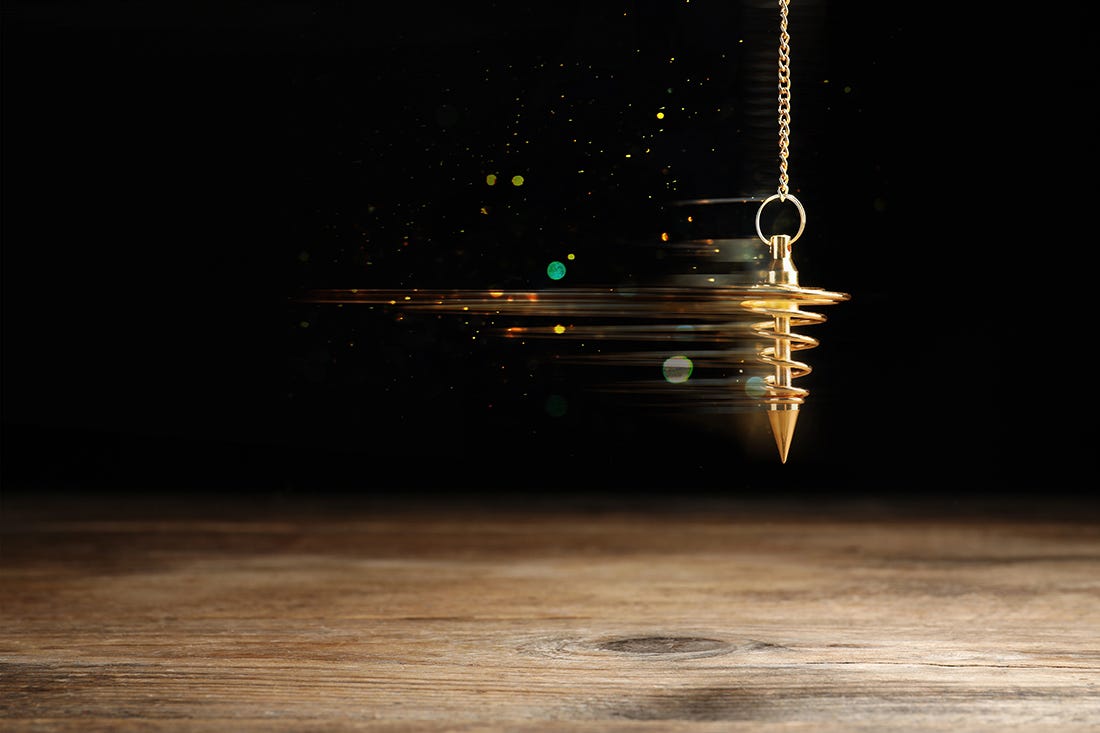
Pendulum
I discovered this fun tool years ago at an Omega Institute conference held in Fort Lauderdale. I was attending as a journalist with the publisher of Balance Magazine. We were seated and waiting for the keynote speaker, Maya Angelou, when my publisher pulled out a pendulum from her purse. She closed her eyes while holding it and then let the pointed stone drop. When the pendulum started to revolve to the right, she immediately took out a pad and wrote some notes.
When I asked, she explained that she used it as a tool to help her make yes-or-no decisions. By holding the pendulum in her hand, closing her eyes and focusing intently on the question, her energy then propelled the stone in one direction or another.
I bought one immediately after Maya Angelou’s inspiring keynote at one of the metaphysical vendors’ displays at the conference and have used it successfully many times. My pendulum plays an important role in the story I tell at the end of this book.
I Ching
According to Divination.com, the I Ching is the oldest of all the classical divination systems. It is also one of the oldest books in the world. Its first interpretive text was composed around 1000 B.C. Although I received the rather thick text as a gift, I found it daunting to use, and more than a bit archaic in language.
Then I discovered a digital version that made a huge difference. In addition to being very easy to use, the content was intentionally updated to reflect more modern language and the removal of sexist terminology.
Think about it, life in the Chinese dynasties of 1000 B.C. didn’t have much to offer to women as far as advice for decision-making since they weren’t even allowed to make them.
The creator of the digital system was a devoted student of I Ching for many years and focused on creating a version that was friendlier for all to use but is still true and accurate to the original. It’s called Visionary I Ching and is available for phone and tablet. There’s a free app with an upgrade to a paid version ($6.99) for full usage of all features. (I am not an affiliate of the product. I just like the tool!)
It is a bit clunky in design as the app originated in the early 2000s, but it’s very usable and lots of fun! Like the original, the digital version relies on your “throws” of the coins and the hexagram results provide the insight.
One important feature to note for any digital divination tool: For it to accurately reflect your energy, the app must allow you to choose the cards, toss the coins, or whatever is relative to that tool. If the device selects for you, it’s a game only and not a projection of your energy.
Tarot and Oracle Card Decks
Tarot has a long history, although not nearly as far back as I Ching. Tarot did not start as a divination tool, but as a card game for recreation in 14th century Europe. Once it began being used for divination, it became widely popular and drew attention from governments and organizations that felt it was a threat to their own authority. Despite repression, Tarot was practiced in private and in secrecy.
The first “recognized” deck with a standardized number of cards, meanings, artwork, and symbols was created in 1910 by Arthur Waite, a popular mystic and poet and published by the Rider Company (now a division of Penguin Random House). The artwork was created by Pamela Colman Smith, and the deck is sometimes referred to as the Rider-Waite-Smith deck or even Waite-Smith.
Some suggest that Ms. Smith was the true creator of both the text and artwork of the deck that has come to be considered the forerunner of modern Tarot. Some say that as a woman, she was restricted or unlikely to be published in her name and so she approached Waite to front the project for her.
Today many versions of the deck are available, but true Tarot is a standardized system of 78 cards, with 22 Major Arcana (Arcana means “secrets”) cards and 56 Minor Arcana cards of four suits. Each card has a significance based on its position in a spread and if it appears upright or reversed. It can be a complex system to learn, but with practice and use, card players can become “readers” of the meanings or can consult a reader for interpretation.
Oracle decks are newer as far as use as a divination tool and less structured. In fact, their appeal is the beauty and fluidity that arise from being unstructured. They generally focus on themes such as angels, goddesses, energy, spirit animals, and many more topics. The lexicon of each oracle deck is established by the author, who is sometimes also the artist, but more often the cards are illustrated in collaboration with an artist.
Once I began dabbling with Tarot and oracle cards, I was hooked. More than simply fun, I found the readings are undeniably and sometimes almost eerily accurate and on-point.
As I used them more and more often, I realized that the appeal for me was not a mystery. I am a reader and a writer. Reading the cards and “seeing” or “receiving” the story was but a short hop from reading a book and being able to discern meaning by intuiting the story between the lines. I’ve become very good at it and feel that card reading is something I’ve done before… a déjà vu to a past life perhaps?
Once you read the story about how I use these tools and where it’s taken me in the next chapter, you, too, may want to stock your toolbox with the proper aids.
Continue to Chapter 4: Putting It All Together.
